Review of my teaching practice by Kwame Baah
My review of Adriano Digaudio’s teaching practice
Review of my teaching practice by Adriano Digaudio
Review of my teaching practice by Kwame Baah
My review of Adriano Digaudio’s teaching practice
Review of my teaching practice by Adriano Digaudio
Giving feedback to students during exhibition install is essential, but can be fraught. This period is ‘the sharp end of the wedge’, with a looming time crunch of a few days or hours on work that may have been developing for up to three years for the student, in the case of a degree show. There are three categories of feedback I identify in an install: necessary, practical and curatorial. Necessary covers elements of safety and accessibility; for example ensuring electrical cables are covered and not trip hazards, or that suspended work does not block a fire escape. Practical covers how to install work, especially when the student’s preparations have not worked in reality. Some real-world examples are: when power sockets that were planned to be used have not been working; when a student’s picture wire is not anchoring to the wall; or when a room in summer has more natural light than the student expected and this is disrupting a projection. Finally, curatorial feedback is more questions of aesthetics and placement, and in install is most common due to how different student’s work in a space sits together and coheres.
For all of these, especially necessary feedback, Its important to assess if the student has understood and taken on board the feedback. Its possible to just act and solve identified problems, but this has little educational value. I always find that a Socratic approach is best: asking the student questions about the topic requiring feedback, to find out what their understanding of the issue is, and once they are drawn to the root cause, if they know how to solve it. Often, students have become stuck down one track of attempted solution that isn’t working, and this questioning dialogue can help them change tracks.
The main disadvantage of this method is that it is relatively time intensive – each student could require open-ended help to get to the point of understanding what needs to be done. A practical example of my approach to mitigate this time intensiveness is the Camberwell End Of Year Show. Students with wildly different needs and mediums are clustered in rooms across two large sites. Just doing a full sweep of the show alone would take 40 minutes. Therefore, I adopt what I call a layering or lacquering approach. This involves visiting each exhibition space in the same order, offering any necessary feedback and being open to practical and curatorial questions from students. Though small quick conversations, I will advance their issue along one step – for example if a student’s work is blocking an access route, I will indicate to them where it can’t be. Some issues I will hand over to a colleague via text – for example ‘can you bring an extension lead to 304 for the sculpture student there’ – and tell the student a colleague will deliver one. I will then complete my sweep of the whole site and start agin, checking in with the students again and offering any new feedback as needed. Eventually, through this lacquering process, rooms are ticked off as ‘done’ on my exhibition spreadsheet, doing ever faster sweeps of outstanding spaces until the whole show is ticked off as ‘done’. This method is essentially working in parallel as much as possible, with students doing the time-intensive work while you’re not there, enacting one’s feedback. It also allows for checking if student’s have understood the feedback easily – you’ll likely be speaking to the same student within two hours on the next sweep, so if they have misapplied the feedback then not too much of their or your time has been wasted, and a new round of questioning can begin.
Presenting student work offsite from UAL throws up a range of challenges, those around appropriateness of environment are some of the sharpest. UAL holds its spaces to a higher standard of physical accessibility than is legally required; where these standards begin and end and if they apply to offsite working are an open, contested question.
A good practical example of this was an offsite show of Painting student work at South London Gallery (SLG). SLG has two spaces, one of which had significant accessibility challenges. Dilston Grove is a listed building, and was the first ever concrete building in Britain. However, this early concrete coupled with its many years as a ruin mean the floor is very uneven, especially the raised rear of the former church, which is accessed by four worn down and uneven steps. One of the students was a wheelchair user, but beyond this, multiple students raised the general principal of accessibility and of showing in accessible spaces. This raised a complex set of questions about accessibility principals, diffuse responsibilities and cost bearing. Broadly: can or should off-site shows be held to the same standard of step-free accessibility as we have at UAL sites; if so, who is responsible for ensuring off-site space accessibility; and finally, if so who pays the cost of ensuring that accessibility?
The challenge was that, if the first principal was kept to, then UAL should not be showing in the SLG at all – Dilston Grove is listed meaning no permanent modifications could be made, for example spending money for the install of a permanent ramp, or levelling out the floor. Changing space was not a decision that could be made in the install week. So, if the show was to go ahead in this non-accessible space, who was then responsible for ensuring adjustments for accessibility? The SLG team argued UAL were, as no previous hirer of the space had raised this issue. The Painting staff argued the Projects & Showcase team (my team) were, as we were producing the overall show. We argued that we had no say in the choice of off-site space, and would not have hired a non-accessible space. Ultimately, this hot potato fell on the SLG team and a portable single storey wheelchair lift was hired, at great expense, to ensure access to the raised area at the rear.
In my assessment, this was an unsatisfactory solution for all parties involved, and has clear lessons for the future. Firstly, UAL staff should either only hire spaces that meet an agreed accessibility criteria, or have a clear ‘party line’ on what the exceptions are – for example showing in a completely unique space such as Dilston Grove. Secondly, wherever possible curatorial mitigations to accessibility should be found – for example in this instance, no wall-mounted work could have been displayed in the raised section, only sculptural work that could be approached from a distance of a couple of metres. Thirdly, specific accessibility needs should be identified wherever possible by tutoring staff in advance – in this instance, the hiring cost would have been much lower if booked months in advance, and that lower cost could have easily been shared between SLG and UAL. And finally, a lesson more for SLG than UAL is to have a better contract – I have been in their position in previous jobs and though ensuring that needs for accessibility adjustments were mentioned in the contract I have had clear protocols for this situation, for example the venue researching solutions that are paid for by the hirer.
In my job, I interact heavily with student written risk assessments (RAs). Student risk assessment has two parallel elements. Firstly, it is a learning experience, where they learn how to write a successful an usable RA, and in a wider sense how to describe and position their own work for public display. Secondly, it is a practical document that is necessary for exhibition opening, and therefore for their work to be seen by their peers and the public. When working with international students, these two different elements both have the be handled differently and with additional care, both for practical reasons of ESOL understanding of potentially technical and specific safety language (for example risk vs hazard), and more difficultly, cultural reasons around what safety is and what documentation is needed. I have had to learn a lot about how credentialised and bureaucratised British society is in the process of teaching RAs to international students, to understand what is unusual in the process for them.
A good practical example of this was my work with a sculpture student from China, Jerry, and his end of year show in 2025. He had a history of ambitious wooden structures that his tutors had responded to well. This culminated in constructing a tree house in the yard of Camberwell College for his degree show. This presented a range of challenges, including several beyond the scope of of a normal RA. With the build, ensuring the work with tools on location was done safely, that the lumber was moved safely and that the build site wasn’t accessible to others – even though it was in an open, outside space. For the work itself, making sure the treehouse wasn’t accessible to anyone but Jerry, as it was approximately 1.8m off the (uneven) ground and making sure it was built securely so it wouldn’t fall on anyone and wouldn’t be damaged in any inclement weather or have any loose snagging protrusions. Unusually it also had to consider planning permission – as a temporary structure it had to remain lower than one storey in height to not trigger the council’s planning team having to inspect it to make sure it wasn’t overlooking the pavement and flats opposite.
All of these complexities would have been challenging even with a native speaker familiar with British permit culture, but working with Jerry presented additional challenges. The work was generally agree to be conceptually solid, and his joinery skill sufficient for his ambitions. However, explaining to him that he had to show, in writing, that he knew what he was doing so that health 7 safety officers he’d never meet would believe that he had this skill was very difficult. Eventually he did submit a risk assessment, however it was clearly partially to entirely LLM generated, which obviously didn’t ‘show his working’ and is not acceptable in a load-bearing part of risk analysis. In the end myself, a colleague and Jerry’s tutor had to write our own parallel RA that essentially assessed the risk of his RA. This was necessary to ensure the work could actually be allowed in the show, but does open up the question of how much he learned, and when an opportunity to fail is more valuable than staff filling in the gaps.
There’s no clear solution to this conflict for future student work – my team are attempting to teach students risk assessment practices and document writing, but it will always be deprioritised in time crunch unless there is a change to the structure of curricula. However, my experience with Jerry was incredibly valuable as a learning experience of where the specific cross-cultural pitfalls might be around formal documentation, that hopefully will net shorten the process next time something like this comes up.
The lecture discussion on learning outcomes made me reflect on my experiences with briefs in further eduction, and the tensions around them in higher education. When undertaking my masters I found learning outcomes and marking criteria incredibly useful reference material throughout the whole process. I treated them essentially as briefs for a series of commercial jobs. I found that as I was studying alongside working full time, this was the only way to efficiently use the fixed and limited time I had for my studies and prevent me using this time on interesting, though not relevant, outputs. However, from speaking to my peers at the time and students at UAL now, this approach seems to be unusual. There seems to be a more general sense of luxuriation in process, or following intuition blindly until you find what you didn’t know what you were looking for, creatively speaking.
Both approaches are legitimate. I’ve also noticed this tension when discussing this with colleagues at UAL – there is often a sense that students come to UAL wanting space to develop rather than proscriptive employability skills. However I feel that as part of creative arts eduction, teaching our students how to follow a brief and create usable deliverables is a great, practical skill for future creative careers. This cuts right to the heart of the question of what art school eduction is for – developing creative expression or learning how to have a creative career.
Thought this my study on this module, I have been thinking about the potential applicability of a relational aesthetics framework to art teaching. Broadly, Nicolas Bourriaud’s theory of relational aesthetics states that the artwork is what exists in the relational space between the audience, artist and art-object. It has struck me that learning, especially in a seminar or art crit environment, could be read in the same way – as a process in which the creative or generative part exists in the fourth, relational space between the others. Of course this mirrors to an extent the dialectic or socratic method, where the learning comes from the student answering their own questions rather than being told the answer; however a relational aesthetics model fully accounts for multiple people in the same space drawing equally from the new object that is crated, learning.
I have previous experience with applying relational aesthetic principals to both gallery public program work and to my own sound art practice, and have found it immensely useful in both contexts. For example, analysing improvised performance as an object that exists between the performer, the performance and the audience, rather than a directional one way act from performer to audience. Also, practically, I have found it a very useful lens to discuss installed work with students – how their work creates a context that an audience exists in to create the overall aesthetic experience. This is often more useful than language around staging or framing as it moves students beyond visual language and towards a deeper understanding of what art can be.
References
Bourriaud, Nicolas. Relational Aesthetics. Les Presses Du Reel, 2002.
Project: Southwark Park Gallery install
Activity: Final Show Risk Assessment
Description: Final dynamic risk assessment of the gallery space to ensure public opening to planned schedule
Hello all. Sorry I will be away next week for the last two days of install at the Southwark Park Gallery Show. We will need to do some final checks to make sure the show can open to the public as planned. These are all the things that need to be done to get us to a ‘safe to open’ stage, in the timescale we have. I’ve written it as a rough method statement, to be followed in order.
Steps in order:
Day 1
Day 2
My microteaching session was entitled ‘An introduction to embodied knowledge: How do the tools we use influence the work we make, both as artists and a workers in a wider sense?’ My goal was to do a very small intro to the idea of embodied knowledge, given the scope of the time we had, grounding the discussion in my own art practice of using tape. This was to be a jumping off point only; I wanted the meat of the session to be a discussion around tools and embodied knowledge. To emphasise this discursive aspect, I had no visual element apart from the tapes and machines I asked the group to interact with.
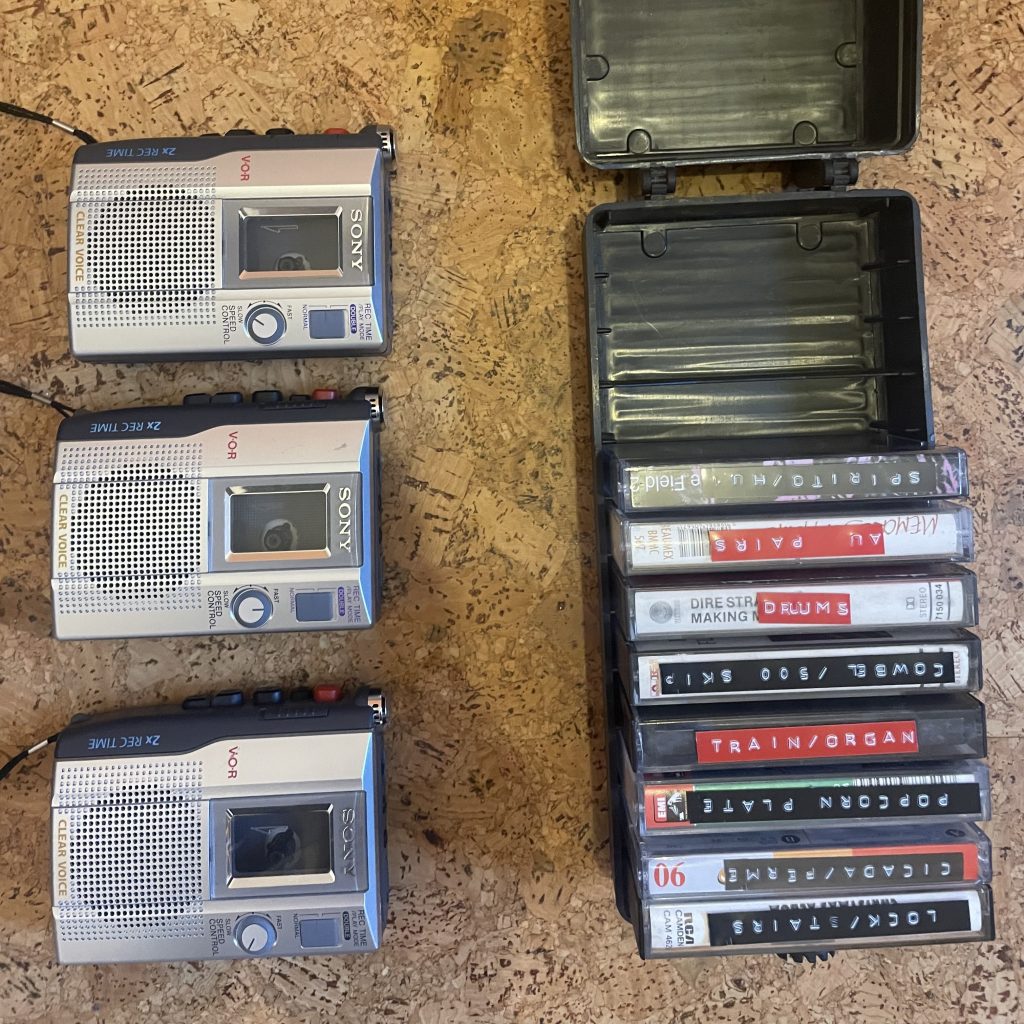
Tape players and machines in preparation
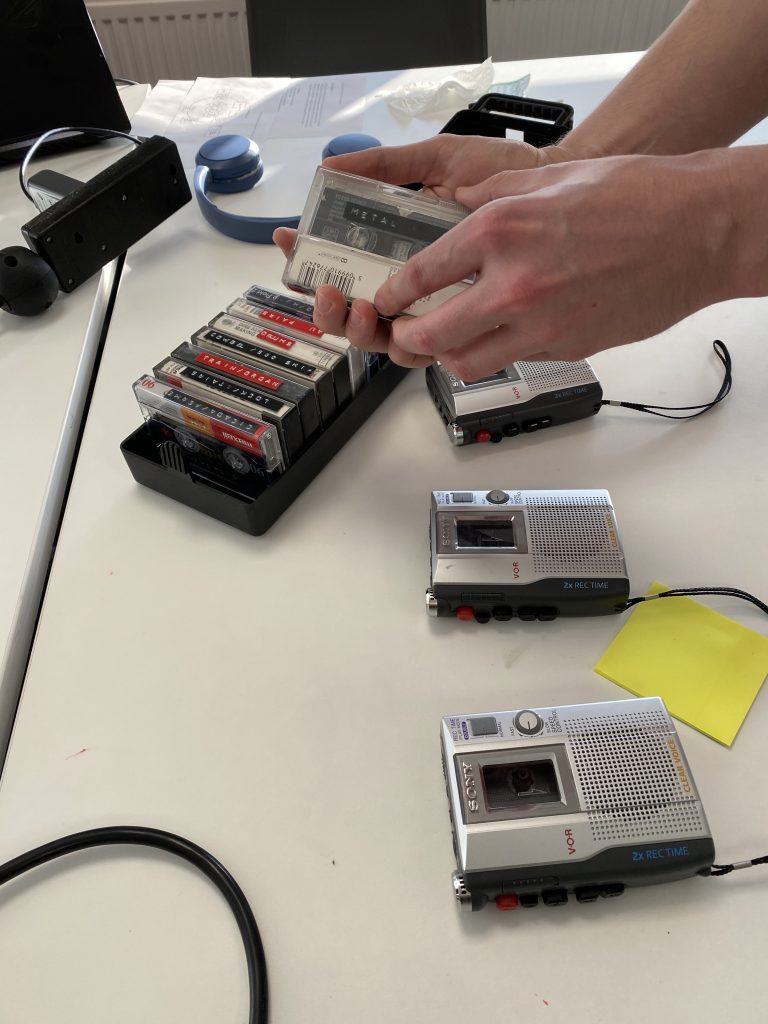
Tape players and machines in session use
I had a written plan to keep to, see below:
In the session itself, the primary challenge was the fire alarm going off halfway though, during our ‘have a go’ section of the plan. This fifty minute gap in the middle threw the flow of the session off a bit, and maybe meant our end concluding section was slightly disjointed from the opening thesis. However, the discursive section went well, and as I had hoped the range of practices and experiences across the group led to a wide ranging conversation around tools and materiality – discussing physical tools versus digital tools, and how students perceive material practices, for example. This was reflected in the feedback I received from my peers on the session, which consistently praised the discussion and my inclusive manner of leading it as a strong element.
I also received some very useful, practical advice on how to improve the session from my peers. These included: having a structured task to work towards, for example me conducting a performance with the machines; bringing in blank tape so the group could record and experiment with their own sounds; me giving a full performance or demonstration, and showing some examples of the lineage and history of tape practice.
Reflecting on my mciroteaching, I felt that the feedback I received was invaluable, as it identified easy to implement practical advice for ‘tape’ element of the session. My deep familiarity with the medium and its artistic history meant that what I had planned as a neutral, context-free engagement with tools was missing key context of what was possible with, and why one would use, this superseded medium for those without my experience.
The small-group discursive section, always my intended primary element, went as much to plan as it could, and I only received positive feedback on this. In a way that is a challenge, as this for me felt like the primary site of learning. In the future, I may want to diverge the two parts, and almost do more sound-focused demonstration work and a more theoretical seminar model session. For example, I could have introduced Bulley & Sahin’s Practice Research as our jumping off point to the same discussion around embodied knowledge, and it may have been a equally valuable session. Though, it would have been less fun and engaging for the participants; this is especially something to consider if adapting this model to work with students.
In our first session, by chance I ended up sitting with technical staff from other UAL colleges, with a range of specialisms and scopes of work. We had all undertaken the same reading, Sams’ How do art and design technicians conceive of their role in higher education? This was a useful jumping off point for a wide ranging conversation about the non-standardised approach to technical & support work at UAL, for example how colleagues on older contracts are sometimes entitled to research budgets and time off the attend gallery openings – contractual elements not available to newer colleagues. We also discussed the unclear and unevenly applied regulations about what support work counts as ‘teaching’, and the frequent frustration around this imperceptible but firmly enforced tipping point. We also discussed my reading of a gap in Sams’ writing; to me, the majority of the issues or frustrations she outlines are commonalities with most knowledge based work in the uk, those of a general alienation from one’s labour, and increasing responsibility/seniority reducing the ratio of time spent on the fulfilling parts of the role – in this case directly helping students.
Additionally, Sams’ research methodology was interesting, especially the use of photography as a conversational object. By interacting with a photograph, the technicians were able to relate to their own work or employment as an outside object, gaining an additional, potentially more objective angle, on their role within the university. I intend to use this model in my forthcoming microteaching session – at this stage I’m thinking of looking at tools, and thinking about the commonalities and divergences in the primary tools we use to produce work, building on my on experience researching embodied performance practices and finding out how applicable that model is to other colleagues’ work and self-conception as practitioners.