Category: UNIT 2

  • IP UNIT: REFLECTIVE REPORT

    My intervention comes from wanting to make risk assessment processes more inclusive of international students, especially students from the People’s Republic of China (hereafter PRC). A large section of the UAL student body, they are currently not well served by the way the idiosyncratic British cultural practice of risk assessment is explained to them. This report examines cross-cultural ways of learning, current processes and differing learning styles, and considers the practicalities of developing new workshops to teach risk assessment.

    This intervention develops directly from my professional context. I am the Producer within CCW’s Professional Practice team; the role’s primary focus is ensuring student showcases, especially degree shows, go as well as possible, and that students are supported to produce their best work. I work directly with students with  more complex or ambitious work, helping them develop successful risk assessments. While valuable, this risk assessment work is one-to-one and time intensive.

    Next academic year, my team will run a range of workshop sessions in CCW’s new undergraduate Unit 9, a year-long professional practice module for 3rd year students. These are adapted from optional sessions we currently deliver, and students will be required to attend at least one. I will be taking over running a workshop on risk assessment. This is a prime opportunity to refocus how students engage with risk assessment processes. In terms of utility, my intention is that this workshop will build students’ confidence and understanding of risk assessment process, especially for students new to UK culture of health & safety. Additionally, the hope is that students who do this workshop will present less complex issues at degree show, meaning a more efficient use of my time than my current one-to-one work with students. This fits into the wider vision I have of my role as Producer flattening the hump of degree show work as much as possible, spreading it throughout the year.

    My team works across CCW, supporting all courses. We aim for an equal level of provision for all students, but at this scale, we can over-rely on ‘one size fits all’ methodologies, for example a reliance on written english instruction and email communication. Looking to increase our inclusive ways of working, International students are a majority at CCW, with students from the PRC being the plurality within that group. Therefore, the single most effective way to increase cross-cultural understanding in our team’s work would be with Chinese students.

    Researching the potential barriers Chinese students face, I found Zhou’s Cross-cultural learning experiences of Chinese international students in a UK university a useful source. Beyond linguistic barriers, Zhou outlines the differences in Western and Chinese pedagogical models. Broadly, the Chinese model draws on Confucian methods, where the educator transmits information to students, while often having a closer, tutelage relationship.1 This is contrasted with the Western model, where the educator facilitates the student’s construction of knowledge; this prioritises training in reasoning models and constructing new arguments from pre-existing literature rather than direct transmission of information.2 
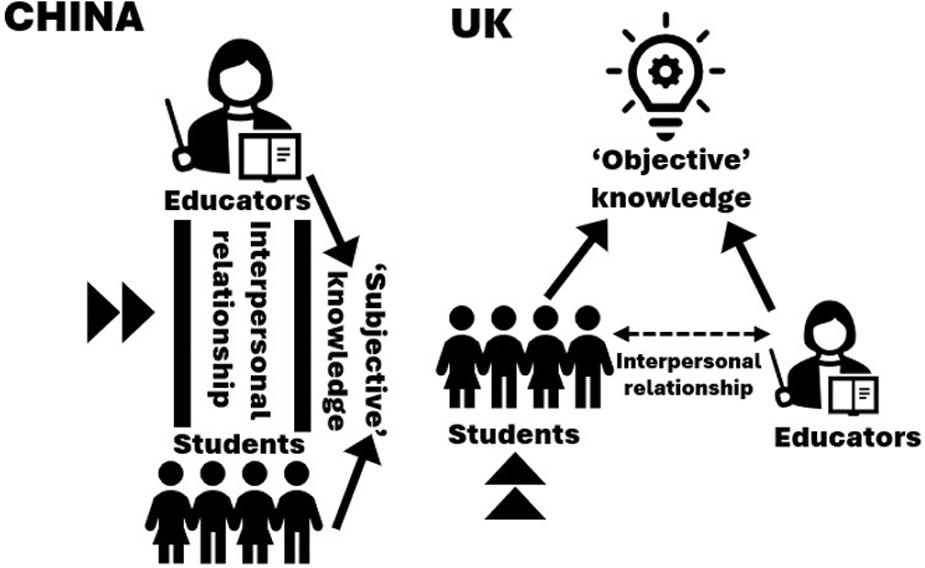
    Fig 1: Interpersonal dynamics and knowledge construction via dialogue (China vs. UK). Adapted from Zhou (2026).

    However, there seems to be a gap in the literature regarding primary research with Chinese art students. Researching art higher education in China, it seems that the educator/student model outlined above largely applies, coupled with the re-founding of the discipline post Civil War with a strong focus on Socialist Realism.3 These two features, arguably more didactic than UK pedagogical models, have been slow to dissipate; I hypothesise this is a strong push factor for staying abroad. This would also accord with Ebel’s research that outlines the relative ease of entry to western courses, coupled with the shortness of UK courses, as key pull factors for students from the PRC.4 This research has been useful in my intervention planning, as it has made me aware of potential inaccessible blind spots when designing for Chinese students, most clearly leaning too heavily on seminar style discussion.

    I feel a truly inclusive, ground-up approach to designing this workshop will be of benefit to all students at UAL. While my focus is on international students, domestic students also not currently served by current ways of working and knowledge transfer around risk at UAL. The hope is we could then learn from this active approach to improving our team’s inclusivity, and find other ways to improve our materials and practices, for example for domestic BAME students, overall increasing access.

    Risk assessment at CCW is a confusing process at the best of times for both students and staff, with a lack of clear understanding of who owns risk, where risk lies, and how risk is assessed. For students, they are presented with documentation that has it’s own intrinsic language and logic. For example, with no explanation of the difference between a ‘risk’ and a ‘harm’, both terms having specific definitions within risk assessment. For staff, there is often confusion  regarding risk ownership. Course leads hold the risk for student work, so if something goes wrong liability initially sits with them. Fear of this leads to a culture of no or minimal risk assessment documentation being seen as ‘safer’ for the academic than rigorous documentation in a kind of ‘what I don’t know can’t hurt me’ manner. 

    From speaking to other colleagues, especially academics, the need for a change of approach towards risk assessment was clear. Clarification of processes and risk ownership was most commonly raised, however this sits outside the scope of what I can effect beyond modelling best practice. Therefore, working ‘bottom up’ with students is a more effective approach. 

    A more holistic approach seems necessary, one which changes the view of risk assessment from as administrative paperwork to documentation of practice within a standard template. A risk assessment should be a living document, that you update as you go, showing your working. A strong risk assessment shows that you have considered something over time, developing best practice as you go. This is very similar to practice research frameworks, of practice (and documentation of practice) functioning as a research output.5 By using practice research, a framework I am confident with, my intervention is able to approach risk assessment training from a fresh angle. 

    One element of this holistic approach will be including object based learning as much as possible. Starting with objects is a consistent method for opening up discussion between groups of students, helping get over barriers of nervousness or self-consciousness.6 This builds on the successes of our install focused sessions; simply starting with ‘what do you think this does’ gets a conversation rolling that then becomes more didactic. The challenge with risk assessment is finding objects to discuss. My proposed solution is to do an install featuring hazards that students can explore and pick apart, almost like an escape room. For example, it could include unsecured cabling, ceiling suspension and work unsecured on plinths. The space would be constantly invigilated by me, but would itself need to pass a risk assessment. The primary challenge is that this may need to be adaptable to different spaces, so specifics will need to be developed at a later date.

    Thinking of my work context, beyond the session itself, I can develop tools for data collection and analysis across my whole team and the range of sessions we will be delivering within Unit 9. This will then allow us to improve the model for next year’s Unit and so on. Personally, it will also allow me to develop as a pedagogue, formalising the ad hoc instructional work I do with students, and building on the criticality I have developed while studying my PGcert. 

    Historically, evaluation of our team’s sessions has been difficult, as they have not been integrated into course structures. We have only really had anecdotal information from tutors about the value of them. Part of the challenge is if they work well, then we shouldn’t see issues present; it is hard to know what not to look for. Collection of feedback from students has also been difficult primarily because of a lack of human resource to process written feedback. The hope is that, though integration in Unit 9, we will be able to better see the progress of students through our sessions and their outcomes at degree show. By cross-referencing students who present with complex risk assessments at degree show with those who have attended the risk session, I might be able to get some information on it’s efficacy. We will also be able to get some breakdown information on home & international students, which will allow me some insight on if my specific attempts at inclusivity have started working. The challenge is, similar to academic courses, we can try and improve for but it will be hard to pivot approach mid-year.

    Overall, while I am confident on my invention being a positive one, it is a relatively large project starting from quite a low base. The opportunity of Unit 9 integration is too good to pass up, but this means that rather than solely improving inclusivity of a pre-existing piece of practice, I am trying to design an illusive practice from the ground up. For me, this feels far more valuable but it will be very hard to tell if it is truly inclusive, specifically of Chinese students, until maybe March next year, and degree show planning.

    1. Zhou, Mengxing. ‘Cross-Cultural Learning Experiences of Chinese International Students in a UK University: A Qualitative Study’. Frontiers in Education Volume 11-2026 (2026), 2 ↩︎
    2. Zhou, 8 ↩︎
    3. Yung, Anthony, and Özge Ersoy. ‘Learning What Can’t Be Taught: Reflections on Art Education through the Story of Six Artists from China’. E-Flux, 4 May 2021. https://www.e-flux.com/education/features/394243/learning-what-can-t-be-taught-reflections-on-art-education-through-the-story-of-six-artists-from-china. ↩︎
    4. Ebel, Pippa. ‘Do We Really Understand Why Chinese Students Come to the UK?’ HEPI Blog, 2 April 2024. https://www.hepi.ac.uk/2024/04/02/do-we-really-understand-why-chinese-students-come-to-the-uk/. ↩︎
    5. Bulley, James, and Ozden Sahin. Practice Research – Report 1: What Is Practice Research? And Report 2: How Can Practice Research Be Shared? British Library, 2021, 4 ↩︎
    6. UCL Museum and Collections. ‘Object Based Learning’. Accessed 29 July 2026. https://www.ucl.ac.uk/museums-collections/working-our-collections/object-based-learning-laboratory/object-based-learning. ↩︎

    References

    Bulley, James, and Ozden Sahin. Practice Research – Report 1: What Is Practice Research? And Report 2: How Can Practice Research Be Shared? British Library, 2021. https://doi.org/10.23636/1347.

    Ebel, Pippa. ‘Do We Really Understand Why Chinese Students Come to the UK?’ HEPI Blog, 2 April 2024. https://www.hepi.ac.uk/2024/04/02/do-we-really-understand-why-chinese-students-come-to-the-uk/.

    Newton, Angela. Student Perceptions of Object-Based Learning. 38, no. December (2025). https://doi.org/10.47408/jldhe.vi38.1619.

    Tate, Shirley Anne, and Paul Bagguley. ‘Building the Anti-Racist University: Next Steps’. Race Ethnicity and Education20, no. 3 (2017): 289–99. https://doi.org/10.1080/13613324.2016.1260227.

    Tohidi, Dayna. ‘A Decade of Object-Based Learning at the CSM Museum & Study Collection’. UAL Central Saint Martins, 10 April 2025. https://www.arts.ac.uk/colleges/central-saint-martins/stories/a-decade-of-object-based-learning-at-the-csm-museum-and-study-collection.

    UCL Museum and Collections. ‘Object Based Learning’. Accessed 29 July 2026. https://www.ucl.ac.uk/museums-collections/working-our-collections/object-based-learning-laboratory/object-based-learning.

    Yu, Jingran, Rohini Rai, Miguel Antonio Lim, and Hanwei Li. ‘The Post-Racial Myth: Rethinking Chinese University Students’ Experiences and Perceptions of Racialised Microaggressions in the UK’. Higher Education 88, no. 5 (2024): 1695–710. https://doi.org/10.1007/s10734-023-01126-5.

    Yung, Anthony, and Özge Ersoy. ‘Learning What Can’t Be Taught: Reflections on Art Education through the Story of Six Artists from China’. E-Flux, 4 May 2021. https://www.e-flux.com/education/features/394243/learning-what-can-t-be-taught-reflections-on-art-education-through-the-story-of-six-artists-from-china.

    Zhou, Mengxing. ‘Cross-Cultural Learning Experiences of Chinese International Students in a UK University: A Qualitative Study’. Frontiers in Education Volume 11-2026 (2026). https://www.frontiersin.org/journals/education/articles/10.3389/feduc.2026.1824782.

  • UNIT 3, BLOG 3 – RACE

    Students from the People’s Republic of China (hereafter the PRC) are a notable section of the UAL student body, around 30% of students in total. This is skewed towards postgraduate level, where on certain courses they make up a plurality of students. However, racism, both structural and individual, against students from the PRC is under discussed at UAL. Yu et al.’s paper The post-racial myth: rethinking Chinese university students’ experiences and perceptions of racialised microaggressions in the UK lays out well the terrain of racism against students from the PRC, and other ethnically Chinese students, though has some gaps when considered in the UAL context. 

    Regarding institutional racism, there seem to be both general and idiosyncratic sources of potential racial othering or discrimination. The post-racial myth identifies long-standing ideas around east asian people in general as ‘model minorities’ in the west, almost being un-racialised and therefore not able to be victims of racism. More specific to HE, there is what they describe as ‘cash-cows logic’,1 where international students (of which PRC is the largest origin in UAL) are objectified as financial instruments to prop up the wider system, and the real education that is taking place, that of the home students. Sectorially, I would argue this is backed up by the lack of interest the Office for Students or wider Department for Education in international students; they are not asked to complete the National Student Survey, and there is no equivalent tracking of quality of education received or outcomes for international students. With the stretched administrative condition of the neoliberalised institution, there is no incentive for UAL to fill in these reporting gaps themselves. Overall, this gap creates a space for institutional racism against Chinese students, treating them as an ‘other’ – maybe not second-class students, but certainly different from the practical focus of HE, domestic students. 

    This neoliberalism reinforces individual racism. The neoliberal view of racism is of something that one individual does to another, rather than structural forces playing a role.2 This meshes well with the western university’s view of itself as a centre of individual research and development. The post-racial myth outlines a good schema for Chinese student’s understanding of racism they have been subject to: it is not racism, it is normal, it is my fault and we are invisible.3 The paper also makes the interesting point that Chinese students may not immediately identify their experiences as racist; they may see it as abuse based on another intersectional identity, such as gender, or as criticism of the CCP government or Chinese culture, separate from criticism of Chinese/Han ethnicity4. 

    Regarding my role, the fact that it focuses on facilitation and showcase of student’s work gives me some lassitude within the institution to ignore the structural gaps I outlined above. There is no penalty, or benefit, for me offering a flat, equal level of provision to all students. I will therefore actively ensure that I do not fall into these prejudices against Chinese students.

    1. Yu, Jingran, Rohini Rai, Miguel Antonio Lim, and Hanwei Li. ‘The Post-Racial Myth: Rethinking Chinese University Students’ Experiences and Perceptions of Racialised Microaggressions in the UK’. Higher Education 88, no. 5 (2024): 1695–710. https://doi.org/10.1007/s10734-023-01126-5., 4. ↩︎
    2. Tate, Shirley Anne, and Paul Bagguley. ‘Building the Anti-Racist University: Next Steps’. Race Ethnicity and Education20, no. 3 (2017): 289–99. https://doi.org/10.1080/13613324.2016.1260227. ↩︎
    3. Yu et al, 13. ↩︎
    4. Yu et al, 7 ↩︎

    Refrences

    Ebel, Pippa. ‘Do We Really Understand Why Chinese Students Come to the UK?’ HEPI Blog, 2 April 2024. https://www.hepi.ac.uk/2024/04/02/do-we-really-understand-why-chinese-students-come-to-the-uk/.

    Tate, Shirley Anne, and Paul Bagguley. ‘Building the Anti-Racist University: Next Steps’. Race Ethnicity and Education20, no. 3 (2017): 289–99. https://doi.org/10.1080/13613324.2016.1260227.

    Yu, Jingran, Rohini Rai, Miguel Antonio Lim, and Hanwei Li. ‘The Post-Racial Myth: Rethinking Chinese University Students’ Experiences and Perceptions of Racialised Microaggressions in the UK’. Higher Education 88, no. 5 (2024): 1695–710. https://doi.org/10.1007/s10734-023-01126-5.

    Yung, Anthony, and Özge Ersoy. ‘Learning What Can’t Be Taught: Reflections on Art Education through the Story of Six Artists from China’. E-Flux, 4 May 2021. https://www.e-flux.com/education/features/394243/learning-what-can-t-be-taught-reflections-on-art-education-through-the-story-of-six-artists-from-china.

    Zhou, Mengxing. ‘Cross-Cultural Learning Experiences of Chinese International Students in a UK University: A Qualitative Study’. Frontiers in Education Volume 11-2026 (2026). https://www.frontiersin.org/journals/education/articles/10.3389/feduc.2026.1824782.

  • UNIT 2, BLOG 2 – BELIEF

    When I encounter faith or belief at work, it is almost always political beliefs rather than religious beliefs. Political beliefs and belief systems can function as religious or philosophical beliefs, and having no religion or belief has the same legal partitions in the UK.1 Especially  when considering international students, the British state’s framing of belief may not fit with that of their home polity. 

    Working on the degree shows across Chelsea, Camberwell and Wimbledon, I get to see the majority of degree show work produced by students at the three collages, across all courses. One of the common themes that surprised me when I fist state at UAL was work by students from the People’s Republic of China (hereafter PRC) reflecting on their relationship to what you could broadly class as liberalism. Often, the work reflects what they had felt as freedom of personal expression they felt they had experienced while living and studying in the UK, and contrasts it with their perceived limits and ‘chilling factors’ on self-expression in the PRC. 

    This self-expression must also been seen in context of “transnational repression” of PRC students and their families back home by security services.2 Amnesty International produced a wide ranging report in 2024 looking at intimidatory tactics faced by students from the PRC & Hong Kong after taking part in protected speech activities in the uk, such as commemorating the 1989 Tiananmen Square protests or Hong Kong pro-democracy protests of the 2010s. Interestingly, none of the students interviewed by Amnesty International were art students. I also spoke to some friends from the PRC, former art students, who also told me they hadn’t experienced these kind of tactics or threats. From this we me may be able to infer that PRC state services care primarily about governmental critique, rather than pro-liberal or personal, interior expression. 

    On one level then, UAL seems to be functioning as a safe place to express these ideas for students from the PRC. But, there may be a chilling effect taking place – students producing work they know is at the limit of ‘safe’ critique.

    On one level, this can be seen as a free speech issue – but it rarely feat in discussions of free speech in higher education. For example, it is not discussed once in the government’s 2021 report that became the 2023 Higher Education (Freedom of Speech act), the current freedom of speech framework which UAL operates in.3. In a sense there is a conflict between two systems – the UK’s long-standing apparatus around protected characteristics, and the transnational efforts of the PRC government to create a chilling effect on free speech for students in the west. I personally think there is no obvious route through this knotty issue, but on a personal level, I can continue to support students in the execution of their work, and follow their lead in any discussion of ideas around liberalism and free speech. 

    References

    ACAS. ‘Religion or Belief Discrimination: What the Law Says’. 29 October 2024. https://www.acas.org.uk/religion-or-belief-discrimination.

    Amnesty International. “ON MY CAMPUS, I AM AFRAID”: CHINA’S TARGETING OF OVERSEAS STUDENTS STIFLES RIGHTS. Amnesty International, 2024.

    Amnesty International. ‘UK: Chinese and Hong Kong Students in UK Live in Fear from Long-Arm of Chinese Government’. 12 May 2024. https://www.amnesty.org.uk/latest/uk-chinese-and-hong-kong-students-uk-live-fear-long-arm-chinese-government/.

    Dragoș, Simina, and Taylor A. Hughson. ‘Furthering Racial Liberalism in UK Higher Education: The Populist Construction of the “Free Speech Crisis”’. The British Journal of Sociology 75, no. 4 (2024): 636–49. https://doi.org/10.1111/1468-4446.13119.

    Higher Education: Free Speech and Academic Freedom. Dandy Booksellers Ltd, 2021.

    Zhou, Mengxing. ‘Cross-Cultural Learning Experiences of Chinese International Students in a UK University: A Qualitative Study’. Frontiers in Education Volume 11-2026 (2026). https://www.frontiersin.org/journals/education/articles/10.3389/feduc.2026.1824782.

    1. ACAS. ‘Religion or Belief Discrimination: What the Law Says’. 29 October 2024. https://www.acas.org.uk/religion-or-belief-discrimination. ↩︎
    2. Amnesty International. “ON MY CAMPUS, I AM AFRAID”: CHINA’S TARGETING OF OVERSEAS STUDENTS STIFLES RIGHTS. Amnesty International, 2024. ↩︎
    3. Higher Education: Free Speech and Academic Freedom. Dandy Booksellers Ltd, 2021. ↩︎
  • UNIT 2, BLOG 1 – DISABILITY

    When I think about my past experiences of disability and intersectionality, the first thing that comes to mind is working with Shape Arts, an organisation that works with and for disabled artists. They have a varied focus on facilitation and production work, helping disabled artists work with institutional structures, such as art galleries, that are often in practice hostile to disabled people even if they state they are inclusive. 

    Shape Arts centres the social model of disability in it’s work, but also insists upon the model’s political nature. For example, they explain that they use the term ‘disabled’ over others such as ‘differently abled’ to centre the social factor, that one is disabled by society and context rather than any inherent facet of the self. 

    Even their web resource explaining the social model is follows the principals of the social model, being available in text, audio, animated and BSL Easy Read (a kind of picture story) formats; the concrete work of broadening access is there from one’s potential first engagement with their work. 

    I remember discussing with Shape Arts staff the idea that society itself is contextual, and non-static. This of course means that someone can be disabled in one context and not anther. But it also provides a goal framework for eliminating ‘disability’ from the world, that we can, through our collective efforts, create pockets of society that are truly accessible, and then expand these until we live in a society without impediment. 

    A recent experience highlights the barriers to eliminating disability (within this framework) at UAL. The Product & Furniture Design course at Chelsea has a student who uses a wheelchair, and the course’s degree show was in The Banqueting Hall – a listed part of the building, with convoluted step-free routes involving a portable ramp and multiple lifts, and behind spring-closed heavy wooden doors. In this instance, there were at least three levels of ‘disabling’ going on, using the social model. Firstly, the building itself has major accessibility challenges that are hard to address due to its being listed. Secondly, the Banqueting Hall space is one of the least accessible spaces within the Chelsea campus, compared to for example ground level spaces, or spaces accessible via only one lift. Thirdly, the access route was itself disabling, as it was reliant on other people to ensure access in the event the ramp was tidied away, and to hold the door open. 

    As part of the Show production team, I worked with the student to address these issues. Each of these was disabling to a different degree, so some reasonable adjustments could be made – for example, ensuring we had a member of invigilation staff in fixed position near the doors who could hold them open as needed for access. However, the least disabling solution would be to have not used the space in the first place and plan around the estate as actually exists; only then would UAL be starting to operate in a proper social model framework, and removing sources of disability rather than adjusting at the edges in the name of inclusivity. 

    References

    Shape Arts. ‘Welcome to Shape’. Accessed 17 June 2026. https://www.shapearts.org.uk/Listing/Category/about-shape.

    Shape Arts. ‘What Is The Social Model Of Disability?’ Shape Arts. Accessed 17 May 2026. https://www.shapearts.org.uk/listing/category/social-model.